All models are wrong, but some are useful
– George Box (1919–2013), British statistician
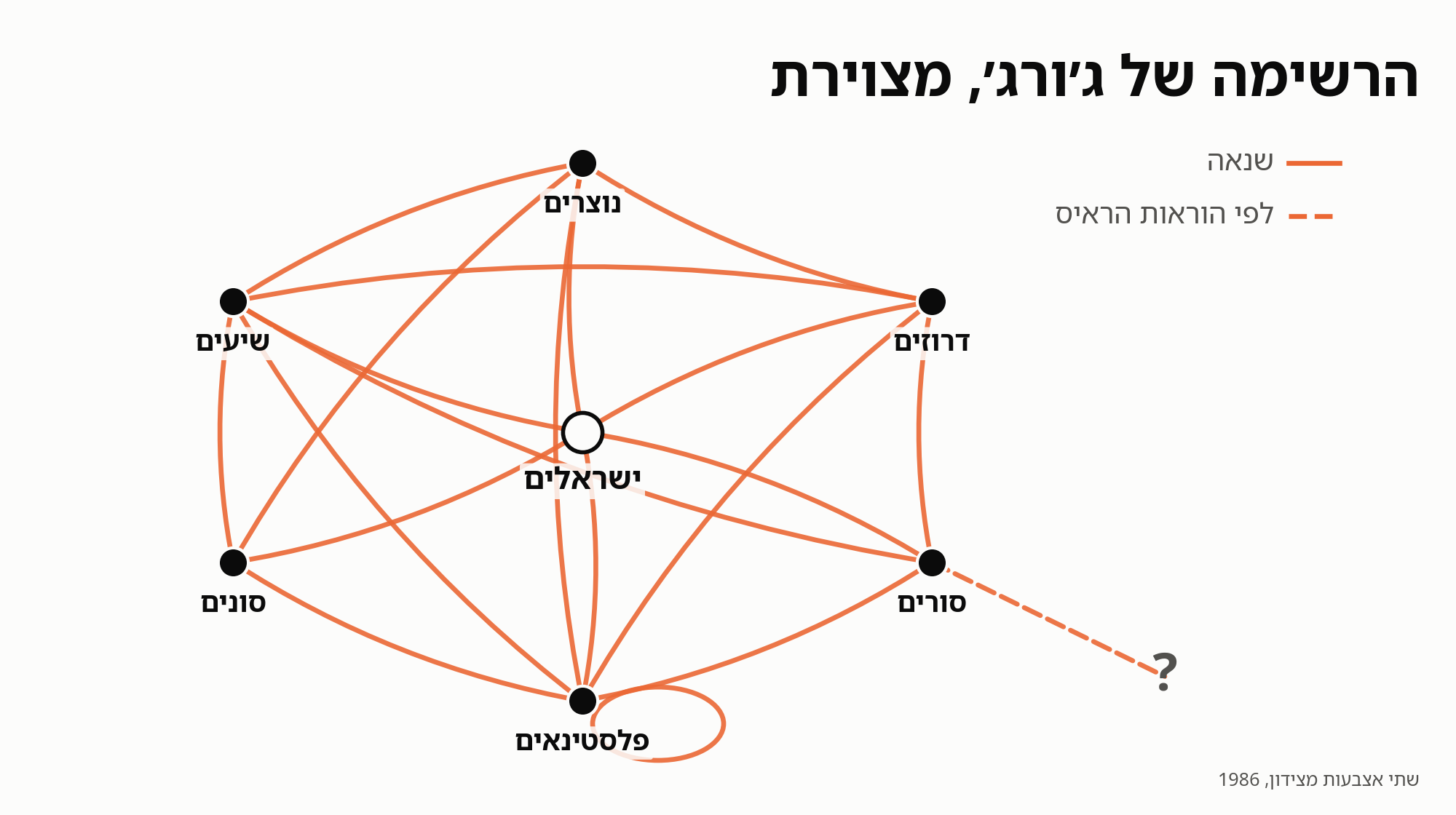
“The Christians hate the Druze and the Shiites and the Sunnis and the Palestinians; the Druze hate the Christians and the Shiites and the Sunnis; the Shiites, they’ve been screwed over all these years, so they hate everyone; the Sunnis hate whoever their rais told them to hate, and the Palestinians hate each other, except that they also hate everyone else. But they all have one thing in common: they all really, really hate us, the Israelis. They’d love to smash our faces in if they could, but they can’t. Because of the IDF.”
– Georgie (Alon Aboutboul), from the film Two Fingers from Sidon
Two Georges, two statements. The first is sure of itself and wrong, the second is hedged and right. The first George (Georgie, that is) gets every detail right and misses the point. He counts hatreds, and that really is what you see. But if you brought a data scientist into his tent, they wouldn’t hear hatred. They’d hear a completely different question: who talks to whom, who is the only bridge between two sides that don’t talk to each other, and what happens to the network when that only bridge breaks.
We explain the world through people: what they believe, who leads them, what trauma they carry. These explanations are convincing, always at hand, and almost always arrive after the fact. They are the story told about the decision, not the reason it was made. This book makes one claim: every player, from a family to a state, sits inside a network: who talks to whom, who trades with whom, who marries whom and who hates whom. Its place in that network, what flows through it and its shape set the space of the possible, and ideology mostly operates inside that space, not on it.
If you know me from the podcast (This Week in the Middle East, Israel’s longest-running podcast about the region), you probably expect a book about the Middle East. That’s not quite it. The Middle East is the lab: the place where these laws work at full strength and are documented more densely than anywhere else. But a law that only works here isn’t a law, it’s an opinion about the neighborhood. Barstool geopolitics, if you like. So you’ll also meet cases from completely different times and places: bankers in fifteenth-century Florence, open-source projects, online editor communities, and one profession (mine, yes) that was born, and also wore out, within a single generation.
One more note before we start. A network is a model, and a model is always a simplification. This book doesn’t claim it’s the only right model. It does something else: it takes one model, runs it all the way, and shows where it breaks. When a case is better explained by economics, psychology or ecology, I’ll say so instead of forcing topology onto it. In the spirit of brutal honesty, the last gate of this book is devoted entirely to the places where the model gave me nothing. Don’t be tempted to see that as weakness. It’s the only way to know there’s a claim here at all.
One theme will come back in every gate: we only ever see the crust, the outer layer of the structure, the one facing us. That layer is the one we can measure, and it bears weight, so it’s easy to draw conclusions from it about what lies underneath. The experts you hear are the crust of an entire field, the consensus you see is the crust of a closed room, and the regime that looks stable is a crust that held until the week it stopped holding. The question that runs through the book is not only what shape the network has, but how you know that’s its shape.
Florence, 1433. The oligarchs, the old families who have ruled the city for fifty years, expel Cosimo de’ Medici from the city, and he moves to Venice. A year later their leader, Rinaldo degli Albizzi, calls on his supporters to gather in the square with weapons and seize power. At the appointed hour only some of them show up. Each one looks at his neighbors, consults, hesitates, and while Rinaldo tries to round up more men, others are already going home. The Medici supporters, by contrast, arrive at once and in perfect coordination at the government palace and take up positions to defend it. All this while Cosimo himself is sitting in Venice. There was no battle. Cosimo returns in a triumphal procession, and the oligarchs are expelled, this time for good. Cosimo de’ Medici took over Florence without an army.
People at the time knew how to explain it: on one side the patricians, members of the old, privileged families that had held power in the city for generations, and on the other the Medici, heroes of the new rich. In the 1990s two researchers, John Padgett and Christopher Ansell, simply counted. The median wealth of a family in the oligarch camp: 21,053 florins. In the Medici camp: 20,874. Statistically, the same. Seniority doesn’t explain it either, because the Medici camp had old patricians aplenty. “This was not a Marxist class struggle,” they write. What separated the camps was not who they were, but who married whom and who did business with whom. The oligarchs married each other, densely. The Medici were the only family that connected families who didn’t talk to each other. And the beautiful part: they didn’t plan it. The oligarchs blocked them from marrying into the patrician neighbors in their own district, and pushed them to look for matches elsewhere. The Medici’s choice, Padgett and Ansell write, was forced on them by the oligarchs themselves. And if this reminds you of something in Israeli politics from 2020 on, I don’t blame you.
Doha, September 2025. Israel strikes the Hamas leadership in the capital of Qatar, a tiny state on the Arabian Peninsula. Within three weeks the Israeli prime minister apologizes on the phone from the White House, and the president of the United States signs an order declaring that an attack on Qatar is a threat to the security of the United States. And in October, Qatar is mediating again. Bombed in September, mediating in October.
A family of bankers in fifteenth-century Florence and a small state in the Gulf. Different era, different religion, different regime, different order of magnitude, and exactly the same move. Neither was the strongest in its surroundings. Both were the only bridge between sides that don’t talk to each other. In Florence this is almost literally true; in Doha, Egypt and the United States also mediated, and still no one found a replacement for Qatar.
And you can produce the same thing in a lab, with no history and no ideology. Three people in a row, and in each round the one in the middle can close a deal with only one of his two neighbors. Whoever is left out asks for less in the next round, and after a few rounds the one in the middle takes about five-sixths of the money. Let him close a deal with both, and the split goes back to roughly even. The power didn’t belong to whoever stood in the middle. It belonged to whoever both sides were competing for.
People at the time explained the Medici by money and class, and today’s commentators explain Qatar by gas and Al Jazeera. Both explanations answer the question of who they are. This book asks where they stood.
What lies ahead
What looks like a trait of a person turns out, again and again, to be a trait of a place. We’ll see why power comes from holding the only bridge over a hole in the network, and why Qatar’s value depends precisely on everyone else being cut off. We’ll see why secret contacts between enemies almost always open through someone marginal and seemingly unimportant, and why Oslo was Norwegian for structural reasons, not by accident.
And here we’ll do something popular network books usually avoid: take one of the most canonical cases in the field and show that it, too, is disputed. A reanalysis of the Florentine family network asks whether the Medici were even the most powerful family. The answer matters less than the fact that the question is being asked.
The rule: before asking who he is, ask where he sits.
Position determines who can. Accumulation determines who already got. These are two laws, not one.
We’ll ask why the same six people explain the region to you in every studio, and discover that attention sticks to whoever already has it. We’ll see the same mechanism at work far from here: a whole profession that was born as a job title, flourished within a decade, was crowned the sexiest job of the century, and wore out when the value migrated to the two ends of the chain, leaving the middle with respectable work and no claim of ownership over anything. And we’ll see how the power to produce knowledge concentrates with those who already hold it, until the small labs disappear from the table without anyone deciding so.
The crust comes back here too: the experts you see are not a sample of the field, they are its top layer.
The rule: attention sticks to whoever already has it, almost regardless of who is right.
Connection is not neutral. It carries some things and destroys others, information above all. We’ll see how a network of alliances meant to deter turned, in 1914, according to one contested reading, a local conflict into a continental war, and why density of ties at some point stops insulating and starts transmitting.
Then comes the uncomfortable chapter: unanimity is not a sign of certainty but of error. In a dense network, analysts sample each other, not the world, and agreement becomes almost free. Here we’ll get into the words themselves and measure how phrasings migrate between rooms, until the same three sentences are heard everywhere and no one remembers who said them first. That is what the failure of October 1973 looked like, what Russian assessments of Ukraine and Western intelligence assessments of weapons of mass destruction in Iraq looked like, and, as far as the evidence lets us say today, what Hamas’s closed planning circle in October 2023 looked like. The same arithmetic, on both sides of every fence.
The non-regional example here is an online editor community, a place where it’s recorded exactly who wrote what and when, so the formation of consensus can be measured instead of argued about.
And before the rule, two steps back from the region. A trial in which five witnesses identify the same person seems stronger than one in which three identify him, but it’s not that simple. This is not a literary flourish but arithmetic: the moment there’s a small chance that all the testimony rests on the same single flaw, perfect agreement is better explained by the flaw than by the truth. That’s why the Sanhedrin used to void a conviction reached unanimously. Whoever formulated that rule had no probabilistic model; they simply distrusted a room with no dissent. The math that justifies the suspicion was written about eighteen hundred years later.
The rule: agreement measures the network of those who agree, not the world.
From the single player to the whole collective. A network of friendships and enmities is unstable in certain triangles and tends to resolve them, and what we call regional realignment is the network repairing itself, with the leaders arriving afterward to supply the reasons.
A community’s fault line exists long before the event that blows it apart, and it can be located through emotional reactions to stimuli that involve no disagreement at all. It’s not diversity that breaks countries apart but alignment: what happens when region, language, community and class divide the same people the same way, and what happens when the divisions cut across each other.
And you can see exactly the same difference at your workplace. When department, seniority, language and floor split the employees into the same two groups, there’s a fault line. When they cut across each other, there’s gossip.
The rule: a group has a shape, and the shape has an opinion about its fate.
Every successful collective reaches the threshold where it stops being what it was. Members grow in a straight line, the ties that need maintaining grow as a square, and that gap is not a management failure but arithmetic. From here we’ll see why movements, undergrounds, companies and communities split, purge from within or institutionalize precisely at the moment of success, and why the cost of exit decides which of the three it will be.
And in open-source projects you can watch the same geometry without blood: forks, purges and departures, where the cost of exit is a single command line.
The rule: a collective usually dies of success, not failure.
A claim that swallows every counterexample isn’t strong, it’s just unfalsifiable. Here I’ll state predictions before showing results, show where I looked for failures, and publish the misses. This book claims that structure constrains, not that it determines, and that difference is measured precisely in the places where the geometry gave me nothing.
The rule: a theory that never loses never wins.
There’s an anomaly in Israel that we saw twice within two years, and almost no one explained it correctly.
Millions of people took to the streets. Then, from the other side of the same argument, millions of others did. The two camps believed opposite things and behaved exactly the same. Neither went out to humiliate the other. Each went out because it felt it was fighting for what was its own. Then the war came, and the very same people showed up again, this time shoulder to shoulder.
This is the case where ideology is the most obvious explanation, and every commentator in the country reached for it. And yet the ideology switched sides and the behavior didn’t budge. What didn’t budge was the structure: a group in which shared exposure to cost stops producing residents, or even citizens. It starts producing owners. A resident lives here, a citizen participates, a shareholder shows up at the general meeting because it’s theirs. Some will see this as a criticism of Israeli society. I see it as a badge of honor.
This also explains the ancient custom of the half-shekel. A regressive tax built on the same idea: an equal payment from everyone, regardless of means, because equal exposure produces an equal expectation of a voice. There, someone designed it on purpose. Here, it happened without anyone designing it.
And from here, the less comfortable part, which must not be skipped. This law doesn’t stop where it’s convenient for me. If shared exposure to cost is what produces owners, then anyone less exposed will behave less like an owner, and that’s true of me too, wherever I pay less than others. The two conclusions go together: an owner’s voice requires an owner’s cost, and widening ownership requires widening exposure. The moment I apply the law only when the result suits me, I’ve swapped a model for an argument.
Everything said about states, undergrounds and communities is true of you as well. Your information is correlated with your neighbors’, your certainty is partly a measurement of the network you sit in, and the experts you listen to are products of the same machine from the second gate.
This part I write about myself, in numbers: my podcast’s guest list as a real distribution, who was invited twice and who was never invited, and how correlated my sources of information are, using exactly the method I applied to the intelligence failures. I don’t know in advance what will come out, and that’s the point.
It’s not time to stop asking why they did it. It’s time to ask, first, where they stood.